

In most labs, pipettes are used thousands of times a day, but technique is almost never revisited. A few microliters off can flatten your standard curves, destroy reproducibility, and make you question perfectly good science.
Here are the key principles of correct pipette operation (air-displacement pipettes):
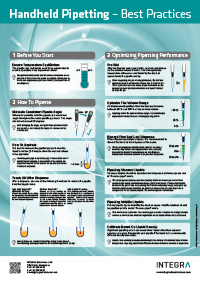
- Set the volume properly: always approach the desired volume from above (dial down, not up) so the internal mechanism settles correctly.
- Fit the tip once, and well: one firm push is enough; over‑hammering the pipette into the rack can deform the tip and affect accuracy.
- Control angle and immersion: keep the pipette close to vertical when aspirating and immerse the tip only a few millimetres below the surface to avoid extra pressure or air intake.
- Pre-wetting the pipette tip
- Use the two stops as intended:
- Aspirate only from the first stop.
- When dispensing, press to the first stop for the set volume, then, wait one second and press to the second stop to blow out the residual droplet.
- Move smoothly and consistently: avoid fast clicks; a steady plunger speed reduces bubbles and variability between replicates.
- Protect your samples (and your data): change tips between samples or reagents, and use filter tips for PCR, DNA/RNA, cell culture and clinical samples to reduce aerosol contamination.
- Look after the pipette: keep it vertical with liquid in the tip, never lying down, and check calibration and cleaning on a regular schedule.
The irony is that we invest heavily in sophisticated equipment, yet a 10–15 minute refresher on pipetting technique could have a bigger impact on data quality and reproducibility than many new instruments.
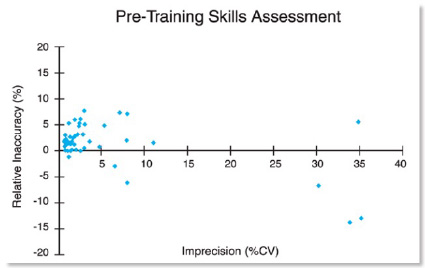
Do you have structured, recurring training on pipette technique in your lab, or do you take the “everyone has their own way” approach?
5 reasons to have pipette handling training at your laboratory:
- Common pipetting technique errors lead to volume discrepancies.
- Volume errors can lead to false assay results.
- Technique training can improve volume accuracy and precision.
- Regulatory bodies are focusing increasingly on personnel skills
- Operator competence makes good business sense.
As distributors of lab equipment and expert advisors in both purchasing and operation, we help labs choose the right tools and use them correctly, from pipettes and other basic research tools to more complex solutions and complete workflows.
We’re happy to help with your questions and requests and support you in getting the most out of your lab.