
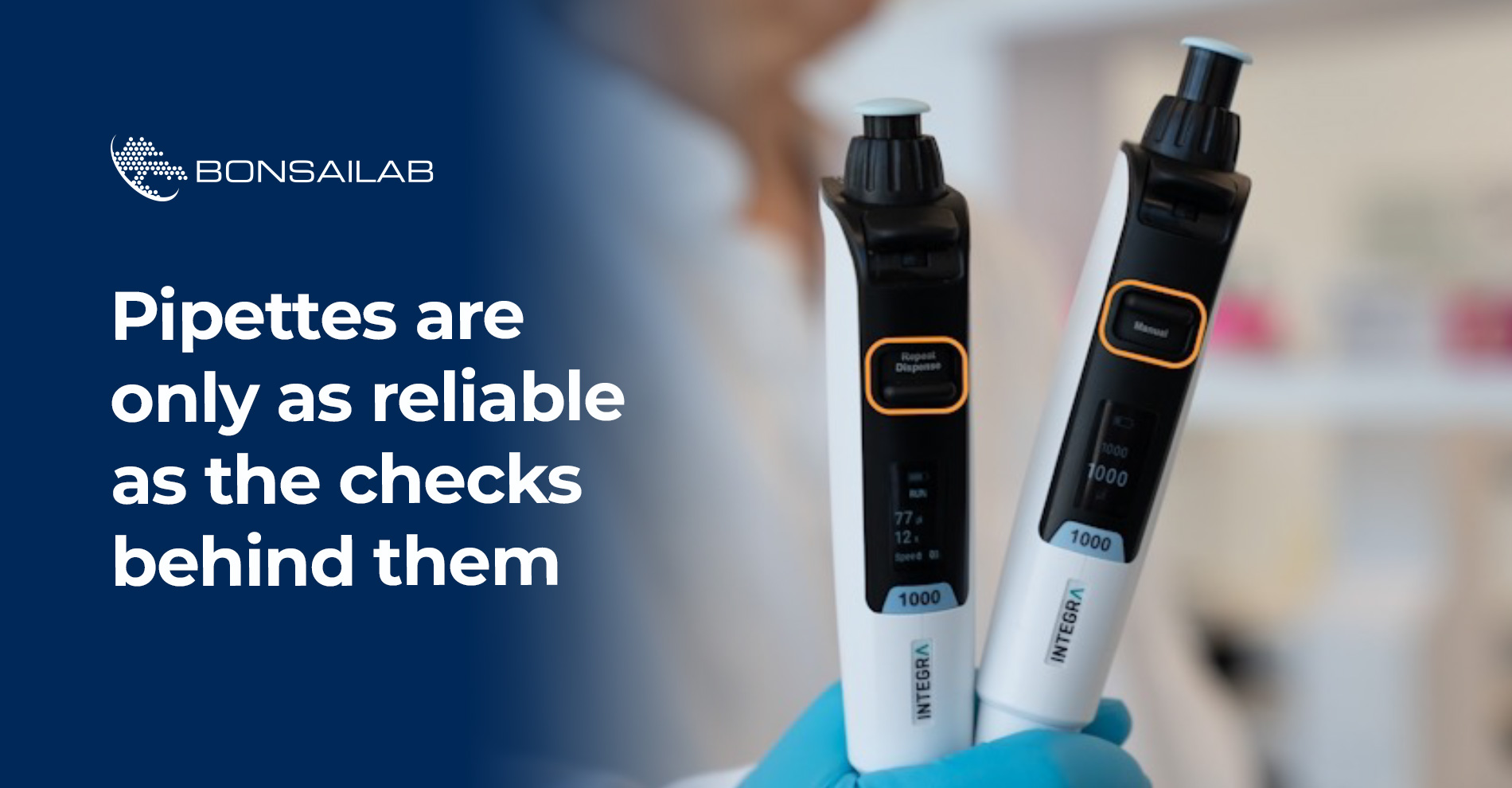
Here’s a clear, lab friendly routine you can use between annual calibrations to stay confident in your data:
1.
Start with the right environment
Draft‑free room, constant temperature between 15–30 °C with no more than ±0.5 °C variation during the test.
Use a balance with draft protection and an evaporation trap, plus a metal weighing container or microcentrifuge tube. Always work with distilled water and the pipette manufacturer’s recommended tips.
2.
Let everything equilibrate
Place pipettes, tips and test liquid in the test room 2 hours before starting so everything reaches room conditions.
Note the date, ambient temperature and air pressure (a local weather station online is fine if you don’t have a barometer).
3.
Perform a quick leak test
- Pre‑wet the tip by aspirating and dispensing the nominal volume 3×.
- Aspirate again and hold the tip about 2 mm below the liquid surface for 30 s.
- Then dispense fully.
If the liquid level drops or you see bubbles, the pipette is leaking and needs service or calibration.
4.
Run gravimetric measurements
At both 100 % and 10 % of the nominal volume:
- Tare the balance with the container.
- Load a new, pre‑wetted tip and dispense along the inner wall, wiping off residual liquid.
- Perform at least 4 measurements per test volume (for multichannel, typically first and middle channel).
- Convert mg to µl using the appropriate Z‑factor, then calculate:
- Mean volume
- Accuracy (systematic error)
- Precision (coefficient of variation, CV)
5.
Decide what to do next
Compare your accuracy and precision with the manufacturer’s specifications:
- Out of spec? The pipette needs calibration.
- Within spec? Your pipette is performing as intended, and your routine check is complete.
Building this simple check into your lab workflow helps:
- Catch performance drift early
- Protect data quality
- Reduce repeat experiments and wasted reagents
Pair routine checks with solid handheld pipetting technique, and you massively cut down on avoidable variability at the bench.
What’s your lab’s current routine for checking pipettes between calibrations?
As distributors of lab equipment and expert advisors in both purchasing and operation, we help labs choose the right tools and use them correctly, from pipettes and other basic research tools to more complex solutions and complete workflows.
We’re happy to help with your questions and requests and support you in getting the most out of your lab.